What Navi is
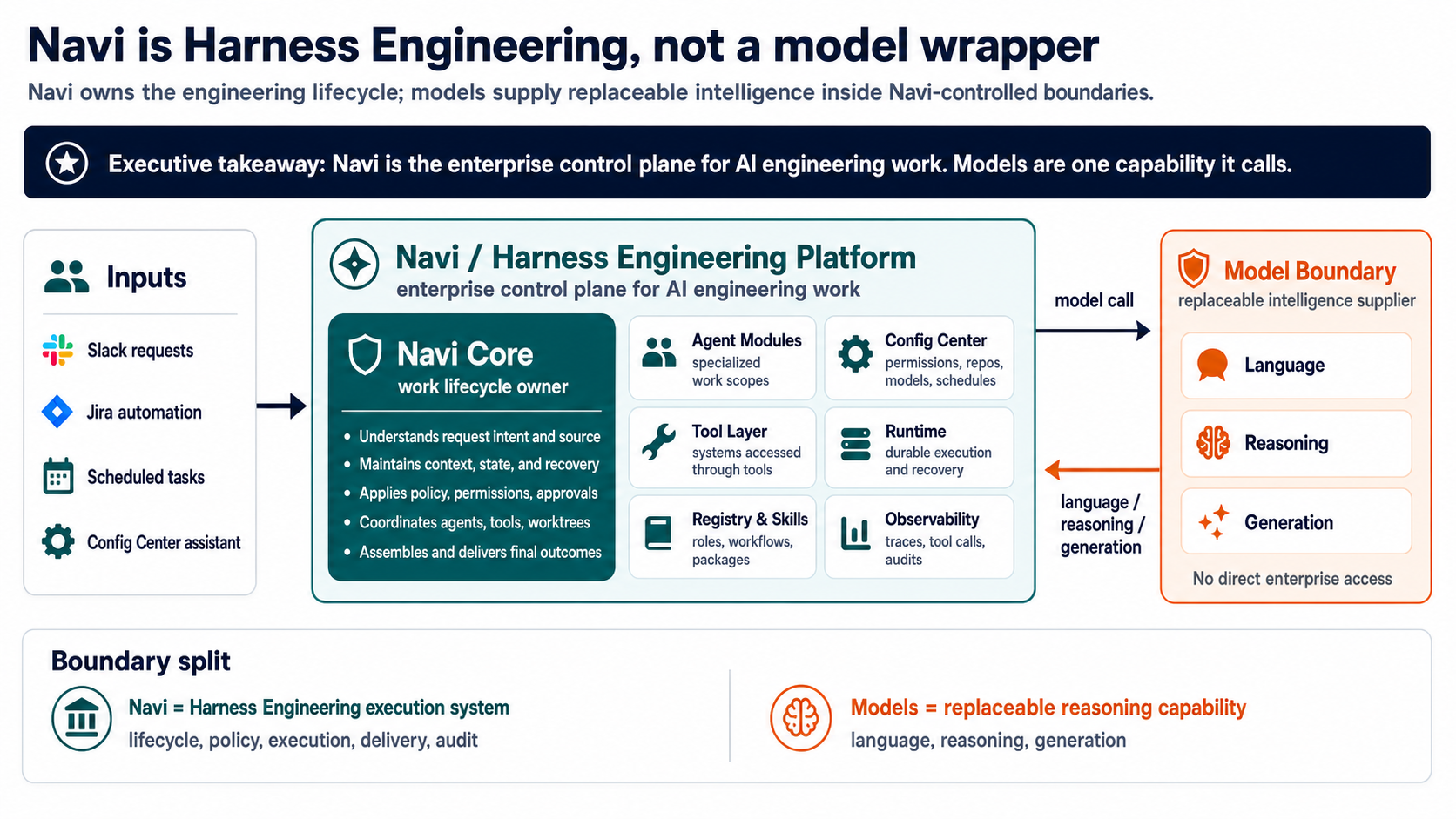
Ask in plain language — in Slack, from a Jira ticket, or on a schedule — and a team of scoped AI specialists does real work across our own systems: code, the data warehouse, monitoring, tickets, Shopify. A human approves anything consequential; every step is on the record.
Not a chatbot that answers — a governed team that does the work, takes one sentence to a finished result, and is accountable for every step.
What it does
Real requests teams make every day — each would otherwise mean opening several tools, pinging colleagues, and waiting.
The value add
The cross-system “find it, switch tools, wait on a colleague” tax every team pays daily is cut sharply — you ask once, instead of chasing it across tools and people.
Scoped access, human approval on risky moves, and a complete audit trail — so it’s safe to open to everyone, not just engineers.
New capabilities are added as configuration, not code, and improve for everyone at once. It outlasts any one person’s laptop.
How it fits — our data, workflows & third-party models
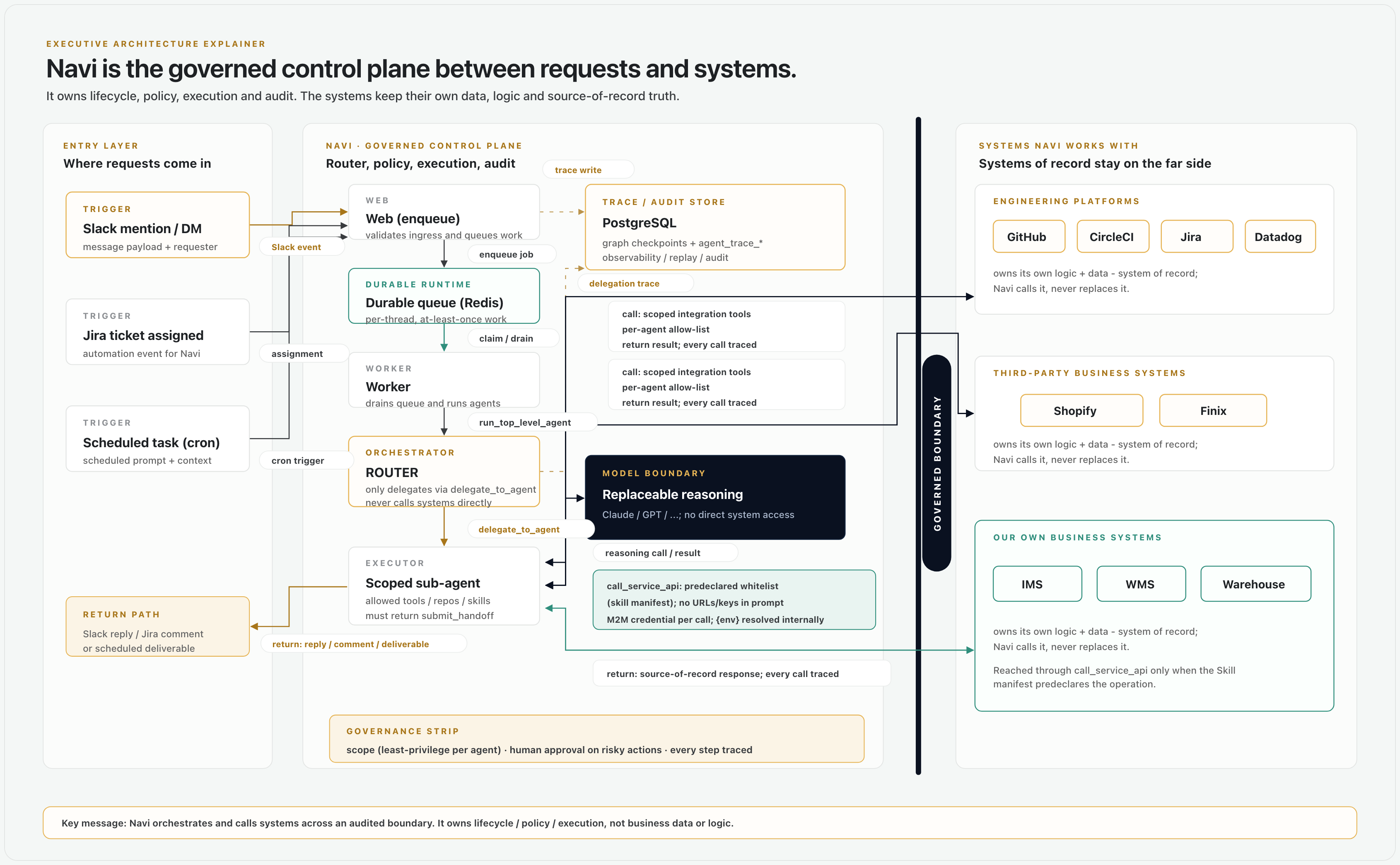
The warehouse, GitHub, Datadog, Jira and Shopify stay exactly where they are. Navi reads and acts on them through standard connectors. It’s the hands that reach into our systems — not another data store, and not a migration.
The “who do I ask, which tool, in what order” that lives in people’s heads becomes a specialist or a reusable skill — consistent, permissioned, and runnable on a schedule instead of from memory.
Navi isn’t tied to any one model — it can run on Claude, GPT, or another, and swap to a stronger one anytime. The model supplies reasoning; everything that makes it safe, reliable and governed inside our company is Navi — the harness around the engine.
The boundary & how it collaborates
Business systems — IMS, the order service, and the rest — stay exactly what they are. The logic, the data, the source of truth all remain theirs. Navi doesn’t reimplement that logic, doesn’t hold that data, and never becomes a business system. When a request needs them, it simply calls the system’s own API.
Each service stays the system of record for its own domain — inventory, orders, payments. Navi never copies it, owns it, or overrides it.
It understands the request, picks the specialist, and calls the service’s predeclared API through one governed tool (call_service_api) — then reports back. It has no business logic of its own.
Navi holds no inventory data and no inventory logic — it just asked IMS on your behalf. And it can only call operations a Skill predeclared (a whitelist); URLs and keys never appear in the conversation, the platform authorizes each call with a machine-to-machine credential, and every call is traced. Governed collaboration — not a takeover.
Navi vs. local Claude Code
Some of us already use Claude Code on our laptops — and should keep doing so. It’s a great personal asset, but a personal asset by nature: it runs as one person, with their access, used by them alone. It can’t stretch to cover the company’s whole business. That’s a different scope — and it’s where Navi lives.
| Claude Code — personal asset | Navi — company capability | |
|---|---|---|
| Who can use it | The engineer who set it up | Everyone, in Slack — zero setup |
| Whose access it uses | The owner’s full access | Scoped per specialist, enforced every action |
| Who approves a risky action | The owner, themselves | A human gate; who-asked kept separate from who-it’s-about |
| If something goes wrong | No central trail | Every run recorded & auditable |
| When the laptop’s off | It stops | Always-on — scheduled & triggered work |
| The know-how built | Stays on the laptop; leaves with the person | Shared — compounds and persists |
Claude Code for the individual; Navi for the company. The same engine — made a governed capability the whole business can run on.